


“We Need Spaces That Feel Like Us”—A Conversation With Beamlak Melesse Bekele
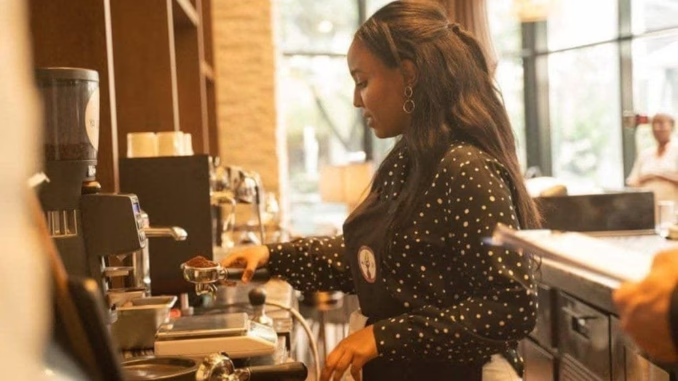
The competitor turned program leader at the African Fine Coffees Association talks sustainability, barista development, and building inclusive community spaces in African coffee.
BY VASILEIA FANARIOTI
SENIOR ONLINE CORRESPONDENT
Photos courtesy of Beamlak Melesse Bekele
Beamlak Melesse Bekele speaks with a sense of ease that comes from having worked across almost every corner of the coffee sector. During our conversation, she pauses only once—to plug in her laptop, as the battery threatens to die—but otherwise traces her path from Addis cupping rooms to continental competitions with clarity and intention.
Her journey spans laboratory work, export management, barista competitions, community-building, and now program leadership at the African Fine Coffees Association (AFCA). Across all of it, she has been thinking deeply about power, equity, and the future of African coffee.

Recognizing Power: “I was conflicted internally and externally.”
Beamlak says her understanding of power in the coffee industry changed most sharply during her time as an export manager.
“I tried to use the relationships my family had built in the industry,” she says, “because big agents and big buyers don’t usually buy from people they don’t know.” But even with that foundation, she found herself caught between loyalty and business decisions.
“Internally I was conflicted, because I believed in relationships,” she continues, “but then I’d see the business flip to someone else just because the prices were high.”
Externally, she faced the difficulty of convincing buyers to pay more for coffee while lacking certifications they were demanding. “It was very difficult,” she says, “trying to communicate value when we didn’t have the certifications or the recognition they wanted.”
This period—around 2021 to early 2023—was the turning point. “That’s when I wanted to transition from export management into work that could actually create impact,” Beamlak says.

What Social Sustainability Looks Like: “Change must be context-sensitive.”
Although the industry often frames sustainability around environmental issues, Beamlak’s focus is social. “I know a lot of people tie sustainability to the environment,” she says, “but I think more about social sustainability and equity.”
For her, a sustainable Ethiopian coffee sector in ten years is one where community leaders shape their own development. “The more adaptable and context-sensitive a solution is,” she explains, “and the more it’s led by the people who live in that environment, the better the outcome will be.”
She also emphasizes the need for deeper collaboration between private businesses and development projects. “There aren’t a lot of private partnerships,” she notes. “NGOs do important work, but connecting businesses with businesses—say exporters with smallholders—creates relationships that can outlast project timelines.”
Meaningful Reciprocity: “We need grounded, authentic exchanges.”
Our conversation turns to the imbalance that often characterizes Global North–South interactions. Beamlak points to her experience in the Cxffee Black Barista Exchange Program as an example of what good reciprocity looks like.
“It was such a great experience,” she says. “It was authentic. We didn’t have to shape ourselves to fit a certain structure.”
She believes this kind of exchange—centered on learning and human connection rather than performance—should be more common.
“Often stories are spoken for you,” she says. “It would be nice to have more grounding experiences where people can share without feeling like they need to fit into a certain box.”
She also notes that origin trips tend to be limited to buyers and importers, while a different approach could broaden perspective: “It would be good to have experiences for people who are not part of the business at that level, but who love coffee and want to understand it more deeply.”

Finding Inclusion: “Even with all my qualifications, some spaces felt overwhelming.”
Beamlak has attended expos in Ethiopia, Europe, and the United States, and she acknowledges that many industry spaces can feel exclusive.
“I have a good command of English, I’m certified, I’ve done the Q course,” she says. “Even with all that, the SCA Expo was very overwhelming for me.”
By contrast, she felt immediately at ease during her first AFCA event. “It was a wonderful experience,” she says. “There were familiar faces. It wasn’t overwhelming. It was engaging and grounding.”
She hopes similar environments can continue to grow, particularly ones hosted at origin. “It’s important to have immersive experiences where people can learn and share genuinely,” she says.

Advice for Young African Baristas: “Make the best with what you have.”
As a former competitor and now an organizer of the African Barista Championship, Beamlak has clear advice for early-career baristas.
“Make the best out of what you can with the resources you have,” she says. “It might not be fair—you might not get the equipment or the coaching you want—but push and do what you can.”
She encourages baristas to compete frequently, even in small events. “Repeating the competition setup helps you get familiar,” she says. “Every stage you go through teaches you something.”

Rethinking Education: “Immersive learning teaches what classrooms can’t.”
If she could redesign coffee education in Ethiopia, she would start by shifting away from flying in trainers for short courses.
“For the cost of certified courses, we could travel to a farm or a processing station,” she explains. “Immersive experiences teach in ways the classroom doesn’t.”
She also believes Ethiopia’s own institutions—such as ECX and the Ethiopian Coffee Board—should be strengthened. “If they had the funding for research, consistent updates, and development, they could be recognized globally,” she says. “We shouldn’t have to rely only on external systems.”

Beyond her AFCA role, Beamlak serves as board president for Women in Coffee Ethiopia and currently helps build the Common Grounds Community Hub in Addis that will offer a lab, roasting space, cupping sessions, and events.
The vision is simple: openness. “We don’t have a specific target group,” she says. “We just want to give people a space to come, learn, and connect.”
Beamlak’s reflections highlight the importance of access, mentorship, and agency for origin-country coffee professionals. Through her work with AFCA, Women in Coffee Ethiopia, Humans of Buna, and Common Grounds Community Hub, she is helping to create spaces where learning, connection, and authentic voices can thrive. As she puts it herself:
“It may be just a drop in the ocean, but it is a drop that belongs to a much bigger wave — one that is rising, reclaiming, and reshaping the future of coffee from the ground up. Come join this movement with us.”
ABOUT THE AUTHOR
Vasileia Fanarioti (she/her) is a senior online correspondent for Barista Magazine and a freelance copywriter and editor with a primary focus on the coffee niche. She has also been a volunteer copywriter for the I’M NOT A BARISTA NPO, providing content to help educate people about baristas and their work.

Subscribe and More!
As always, you can read Barista Magazine in paper by subscribing or ordering an issue.
Support Barista Magazine with a Membership.
Signup for our weekly newsletter.
Read the December 2025 + January 2026 Issue for free with our digital edition.
Source: Barista Magazine