


A Shift in Focus: How Café Owners in Australia Are Navigating a Challenging Market

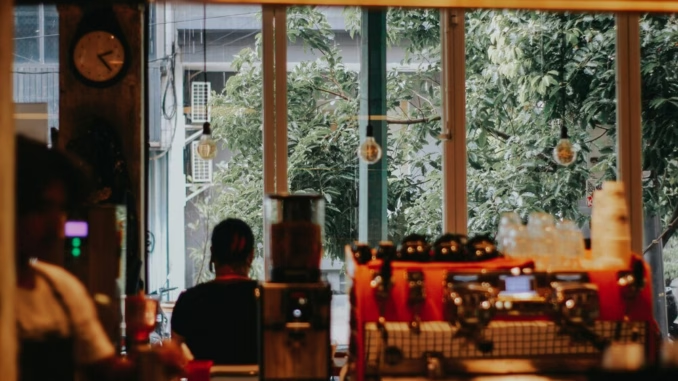
Running a coffee shop today requires more strategy than ever before—and Australian café owners are embracing community as vital to their survival.
BY JOSE CHAVEZ
BARISTA MAGAZINE ONLINE
Featured photo by Falaq Lazuardi
What to know:
- Café owners in Australia are navigating rising costs, reporting margins as tighter than ever before
- As a response, many coffee shop operators are shifting their focus to community—developing strong relationships with both their teams and their customers
- Community-centered events like art exhibitions and weekend workshops are helping drive business
In the past few years, there has been a tremendous transformation in Australia‘s independent café environment. Increases in ingredient prices, changing customer demands, and a post-pandemic reevaluation of hospitality culture have forced many coffee shop owners to reconsider not only their menus, but their entire business models.
What was once a fairly simple business—requiring good coffee, good service, and loyal regulars—has now become a delicate balance between business survival and proper engagement with the community.
A very real cost crunch
Many café operators express concern that hospitality is being struck down by inflation. From dairy and syrups to equipment maintenance contracts, café owners around the world are saying that margins are tighter than ever. In a 2023 survey, the National Restaurant Association discovered that 90% of operators listed food and labor expenses as their major operational issues.

For many café owners reporting challenges, the solution has been to step back to the drawing board—to source smarter, cut waste, and form supplier relationships that prioritize both reliability and quality.
Allying with wholesale suppliers of coffee is one decision that has proven to be strategic amongst independent coffee shops who are interested in keeping input costs down without compromising the quality of their offerings.
“We used to change our bean supplier every time we found something slightly cheaper. But we learned quickly that consistency matters more than a few cents per kilogram,” says Marcus Tan, a café owner based in Melbourne. “Building a real relationship with a wholesaler changed everything. We get better pricing and better communication—and our customers notice the quality.”
Investing in people, not just product
One of the most impressive shifts in Australia’s café culture is a changing approach to the training and development of staff. For forward-thinking coffee shop owners across the country, developing a strong team is no longer treated as an overhead cost, but as a competitive advantage.
Taking the time to train formidable baristas—whether by leading training themselves or enrolling team members in barista courses—has proven to be central to many café owners’ strategies, directly influencing retention, morale, and the uniformity of each cup of coffee served.

And this philosophy isn’t limited to technical skills like dialing in espresso or pouring latte art. Emma Richter, a hospitality consultant based in Victoria, explains that employees confident in their coffee skills tend to be more assured in their interpersonal skills, too.
“The cafés that are thriving right now aren’t just the ones with the best equipment. They’re the ones investing in their people,” says Emma. “When a barista feels like they’re growing professionally, they bring that energy to every customer interaction. That’s where real loyalty is built.”
For many consumers, cafés aren’t just spots to get coffee; they’re third places and meeting points—important institutions of the neighborhood. The most robust café owners are embracing this, making efforts to connect with their surrounding communities and seeing them as the foundation of their business.
Cafés are strengthening their relationships with their patrons by hosting pop-up events, exhibitions with local artists, and weekend workshops, and introducing loyalty programs that reward regulars. These programs do not necessarily need huge budgets, but they need deliberateness and uniformity.
Upgrading the customer experience at every touchpoint also matters. Offering thoughtfully curated coffee accessories as part of an in-café retail experience has become a second source of revenue for clever proprietors, helping regulars take the coffeehouse experience home with them while also strengthening brand association outside of the café’s walls.
A new kind of growth
What does growth look like for the modern independent café? Increasingly, it doesn’t mean opening a second location or scaling toward a franchise. It involves deepening relationships, making your business more vital to the community already being served, and becoming more conscious of the culture being created by your shop day by day.

The owners of cafés that prevail in competitive markets have a few things in common: They are data-informed without being cold, people-focused without losing sight of margins, and community-driven without abandoning the operational fundamentals that keep the lights on.
This shift in focus is not a retreat; it is a growing up. And to those who are willing to change their approach, the specialty coffee business can become one of the most satisfying arenas within hospitality, whereby they can create something really substantial.
ABOUT THE AUTHOR
Jose Chavez is the founder of Ready to Rank Digital Marketing Agency and a contributor for Bean Around Town, a specialty coffee hub helping café owners and enthusiasts find the best beans, gear, and training across Australia.

Subscribe and More!
As always, you can get a hard copy of Barista Magazine by subscribing or ordering an issue.
Support Barista Magazine and show your love with a Membership.
Signup for our weekly newsletter.
Join us at Camp Coffee Shop Aug. 10-13 in Napa, California.
Read the April + May 2026 21st Anniversary Issue for free with our digital edition.
For free access to more than six years’ worth of issues, visit our digital edition archives here.
Source: Barista Magazine