


Coffee Mkulima: The Digital Platform Transforming Coffee Farming in Kenya

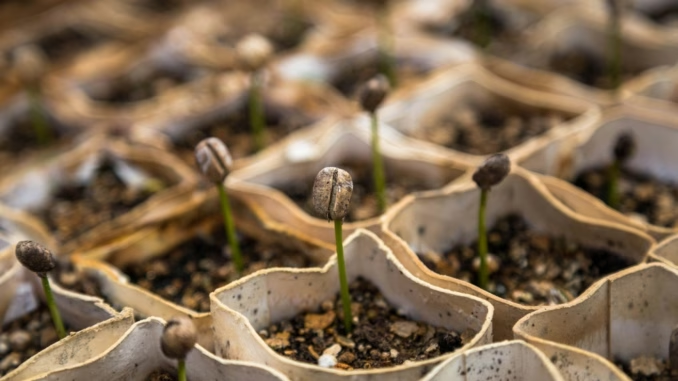
Developed by leaders in Uasin Gishu County, the digital platform seeks to strengthen Kenya’s coffee sector by providing producers with critical growing information.
BY DANIEL MURAGA
BARISTA MAGAZINE ONLINE
Featured photo by Christian Joudrey. All other photos courtesy of Uasin Gishu County.
What to know:
- Coffee Mkulima, a new digital platform developed in Kenya’s Uasin Gishu County, is helping local coffee producers better monitor seedling distribution
- The platform is part of the Kenyan government’s move to expand the country’s coffee sector and support the nation’s growers
- As of today, Coffee Mkulima has provided support to over 20,000 coffee farmers in Kenya
In the heart of Kenya‘s Rift Valley region, a new digital platform is seeking to revolutionize coffee farming for years to come. Developed by the Information Communication and Technology (ICT) Department of Uasin Gishu County, Coffee Mkulima has set out to modernize coffee production in the area.
The online portal was created to track coffee seedling distribution, replacing tedious manual record-keeping with a GPS-enabled platform that monitors seedlings in nurseries, during distribution to farmers, and eventually, in the field. In doing so, it promises to improve yields, soil management, and disease resistance.

Today, we’ll speak with leaders in Uasin Gishu County to learn more about the innovative platform and how it’s already begun to make a difference for Kenyan coffee producers.
Coffee farming in Uasin Gishu County
Located in the North Rift region of Kenya, Uasin Gishu County covers an area of about 3,345.2 square kilometers (approx. 1,291 square miles) with a population of approximately 1.3 million, based on data from the Kenya National Bureau of Statistics (KNBS) census. With high, consistent levels of rainfall, the county also has one of the most favorable climates for coffee farming in the country.
To boost farmers’ incomes through agriculture and crop diversification, the county is currently shifting from traditional subsistence farming of crops such as maize (corn) and wheat, to coffee. Efforts underway include training for farmers and county administrators, and the construction of a local coffee milling plant to support the growing coffee sector.

“Our focus on strengthening the coffee sector remains deliberate and firm. That is why we are prioritizing the completion of the Cheramei Coffee Milling Plant,” says Governor of Uasin Gishu, Jonathan Bii Chelilim. “By processing coffee closer to our farmers, we will enhance returns, create new opportunities along the value chain, and ensure that the hardworking growers benefit more from their produce.”
Apart from the construction of the coffee milling plant, other efforts to strengthen Kenya’s coffee sector include forming coffee cooperative societies and focusing on quality coffee production. These efforts have laid the foundation for new digital technology like Coffee Mkulima—and though the platform only officially launched last month, more than 11,000 farmers have already registered.
Using technology to manage coffee
County administrators are banking on Coffee Mkulima to enhance transparency, improve accountability, and promote efficiency in the county’s coffee-growing communities. Through the platform, registered farmers can apply for coffee seedlings, access coffee markets, get professional advice, and benefit from support directly from the county.
When launching the platform, Deputy County Governor Evans Kapkea said the platform is designed to offer practical, easily accessible, and farmer-centered services. “The platform will provide growers with critical information, including soil-zone maps, planting records, rainfall risk alerts, pest and disease hot-spot updates, and market access routes through Geographic Information System (GIS) integration,” says Evans.

To prepare the ground for the adoption of the technology, Evans also planned for a three-day training exercise for farmers and county agricultural extension officers. Already, Ward Agricultural Officers (WAO) in all of Uasin Gishu’s six sub-counties have undergone training done by officials from the Climate Change Unit (CCU) and the County ICT department. This training took the officers through the correct criteria and procedures for authenticating applicant farmers and determining who is eligible for the service.
Reaping the fruits of Coffee Mkulima’s technology
Currently, Coffee Mkulima has positively impacted the lives of over 20,000 farmers, with more than 66,000 coffee seedlings distributed. According to records, 11,211 farmer applicants successfully registered on the portal before it was temporarily closed to allow for the next stage, applicant verification.
The digital platform aligns with the Kenyan national government’s goal of increasing coffee production in Kenya from 50,000 tons to 150,000 tons by 2029, under the much-touted Bottom-Up Economic Transformation Agenda (BETA).
“The portal is designed to ensure transparency and accountability in seedling distribution while providing farmers with accurate information to support their production,” says Evans.
ABOUT THE AUTHOR
Daniel Muraga (he/him) is a communications expert, researcher, writer, and editor based in Kenya with over 10 years of experience in the industry. His mission is to highlight Africa’s contributions to the realms of science, technology, innovation, culture, food, and related fields. He has done extensive research and written widely in the coffee niche for Sprudge Media, as well as in related areas for Life & Thyme and CQ Researcher, among others. When not writing, he is always outdoors communing with nature. You can find him on Facebook, X, and LinkedIn.

Subscribe and More!
As always, you can get a hard copy of Barista Magazine by subscribing or ordering an issue.
Support Barista Magazine and show your love with a Membership.
Signup for our weekly newsletter.
Join us at Camp Coffee Shop Aug. 10-13 in Napa, California.
Read the April + May 2026 21st Anniversary Issue for free with our digital edition.
For free access to more than six years’ worth of issues, visit our digital edition archives here.
Source: Barista Magazine