

What is ultrasonic coffee? – BeanScene

Australian researchers have developed a new way of brewing coffee that could transform large-scale production and RTD manufacturing.
Dr Francisco Trujillo remembers a childhood in regional Colombia, where his grandfather bought and sold coffee.
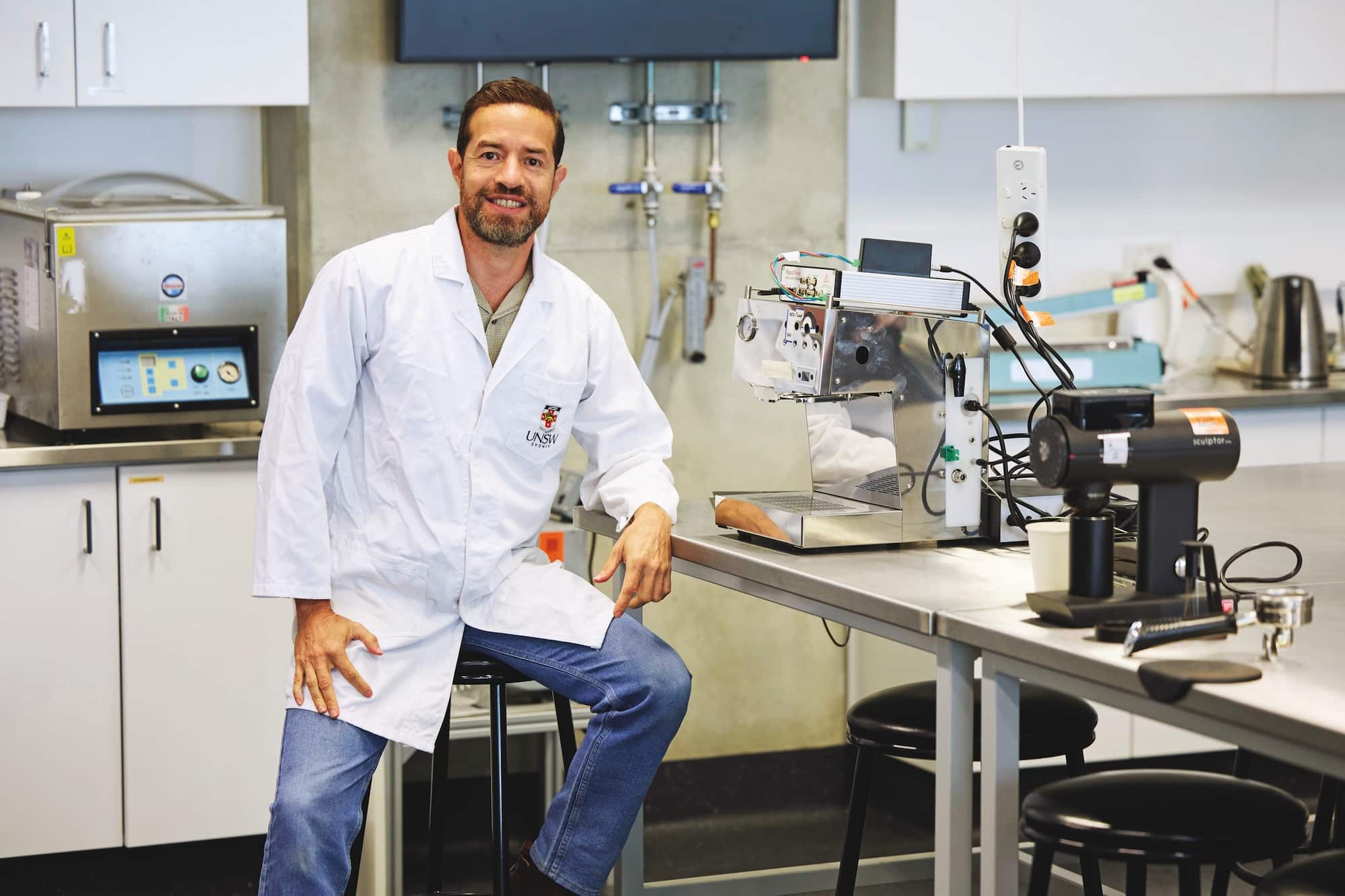
Now, the Senior Researcher at Sydney’s University of New South Wales is redefining how coffee can be brewed efficiently. His research team have developed a new method, which they call ‘ultrasonic espresso’, that offers up to 75 per cent energy savings compared to traditional espresso production.
The ultrasonic journey started with using similar methods to create cold brew, the result of which dropped the standard 12- to 24-hour process to just a few minutes. Then, they turned their attention to replicating and refining the process for espresso.
“The first work we did was trying to replicate cold brew, we published those results in 2024,” says Francisco.
“Then we said, ‘this is an espresso machine – can we do something as concentrated as an espresso?’ That was the important question.
“We started to manipulate variables and realised, yes, we could – which was how the idea started.”
This coffee research is a full circle moment for Francisco, a chemical engineer with a PhD and post doctorate focused on food processing, which he believes is a “beautiful part” of the story.
“I grew up in my grandfather’s house. We lived in a small Colombian town close to the mountains where they grow coffee, and one of my grandfather’s businesses was buying wet coffee beans,” says Francisco.
“He would put them out to dry in the sun on these long sheets made from natural fibres. The smell of wet coffee beans was very strong, I still remember it now. I have it recorded in my brain from when I was a kid. We used to play among the coffee beans.”
How it works
Traditionally, espresso relies on hot water pushed through finely ground coffee under pressure. The heating of the water is one of the most energy-intensive parts of the brewing process.
Instead of relying on heat, Francisco’s method uses ultrasonic soundwaves to vibrate the water and coffee at a high frequency, creating acoustic cavitation.
This cavitation creates and collapses tiny bubbles in the water, which act like microscopic agitators that help break open the coffee grounds and extract the desirable compounds.
“Ultrasound has been widely used for extraction; it’s a very well-known technique in food processing,” says Francisco.
“If you have a vegetable tissue that you want to extract something from, the acoustic cavitation produces tiny holes in the membranes and that allows the solutes to be extracted more easily. That’s been reported for several decades.”
He applied the same method to coffee. “We did a study to find out if ultrasound could extract more of coffee’s antioxidants. We found it extracted about the same as a normal extraction or brewing, but there were a lot of other differences,” says Francisco.
“We saw it was emulsifying the oils, so when we applied ultrasound, the coffee wasn’t as dark. It was a bit creamier and it lost some transparency.
“Then we measured some volatile components and saw the emulsion – basically tiny droplets of coffee oil – was carrying certain aroma compounds.”
The initial study used huge lab machines with large beakers of coffee, which Francisco labelled “impractical” for real-world use. As a result, his team adjusted an espresso machine to vibrate the portafilter basket to extract and brew the coffee.
“We were essentially transforming the basket inside the portafilter into a resonator,” Francisco continues.
“We designed a system that touches the coffee basket on the side, then it starts resonating. By doing that, it produces waves from the outside of the basket towards the inside.”
The size, shape, and structure of the portafilter proved perfect for creating acoustic cavitation.
“The sound isn’t just passing through the point of contact; it’s passing from all the walls around, inwards,” says Francisco.
“We know acoustic cavitation is very strong when you’re close to the source that produces the sound, but it diminishes very quickly with distance.
“In a small coffee basket, where the source is now all the walls of the basket and the coffee surrounds it, you have the perfect geometry to create a lot of acoustic cavitation and enhance the extraction.”
It’s the power required to vibrate the portafilter, compared to heating water to pass through, where the major energy savings come into play.
“We recorded that from zero to about 60 watts there was a large increase in extraction yield. From 60 to 100 watts, extraction still increased, but not as much,” says Francisco.
“We can operate the system at about 60 watts, which is where we get the best energy savings while still achieving strong extraction.
“We believe that, if you greatly increase the power, you might be able to extract faster, but 60 watts is a very critical point where you get most of the benefit.”

What’s next?
As part of the evaluation process, Francisco and his team recruited 100 regular coffee consumers to taste test the ultrasonic espresso alongside traditionally brewed espresso.
The statistical results of these consumers indicate little to no difference assessed between the brewing methods. A number of coffee experts were also recruited to taste test the final product.
“The expert tasting results are anecdotal because we don’t have statistical data, but most of them report slightly less bitterness and a cleaner aftertaste,” says Francisco.
“An expert might detect specific flavour notes that are more associated with cold extraction or hot extraction, but we’re not claiming there is ‘no difference’ at all.
“Coffee extraction is extremely complex, and with espresso, if you change something just a little, you change the espresso. We are changing things by brewing with sound waves at room temperature with room-temperature water.”
Now, the work will continue refining the process to drop the brew time from about two minutes to something closer to the 30 seconds associated with traditional espresso.
“We want to follow two main pathways. One is to work with a company that’s interested in bringing this to market in the form of coffee machines,” says Francisco.
“The second pathway, which we see as having the biggest potential, is partnering with companies interested in large-scale production of ready-to-drink coffee beverages and cold brew.
“In large-scale production you’re already working on longer times, and ultrasound can dramatically speed up extraction even under cold or lower-temperature conditions. You can also model the process and decide, for example, that you don’t need such high temperatures or high pressures.
“All of those elements together could make the process highly efficient: reduced time, reduced energy, and maintained or even improved quality.”
This article appears in the August 2026 edition of BeanScene. Subscribe HERE.
Source: Bean Scene Mag