

China's Up-and-Coming Espresso Machine Manufacturer Wendougee is Challenging Italy's Long-Held Espresso Dominance – CoffeeTalk

The landscape of coffee equipment is undergoing a seismic shift. For decades, Italian manufacturing was the gold standard for espresso excellence, while Chinese manufacturing was often relegated to the background, seen primarily as a source for budget-oriented imitations. However, brands like Timemore, BooKoo, and now Wendougee are challenging that narrative.
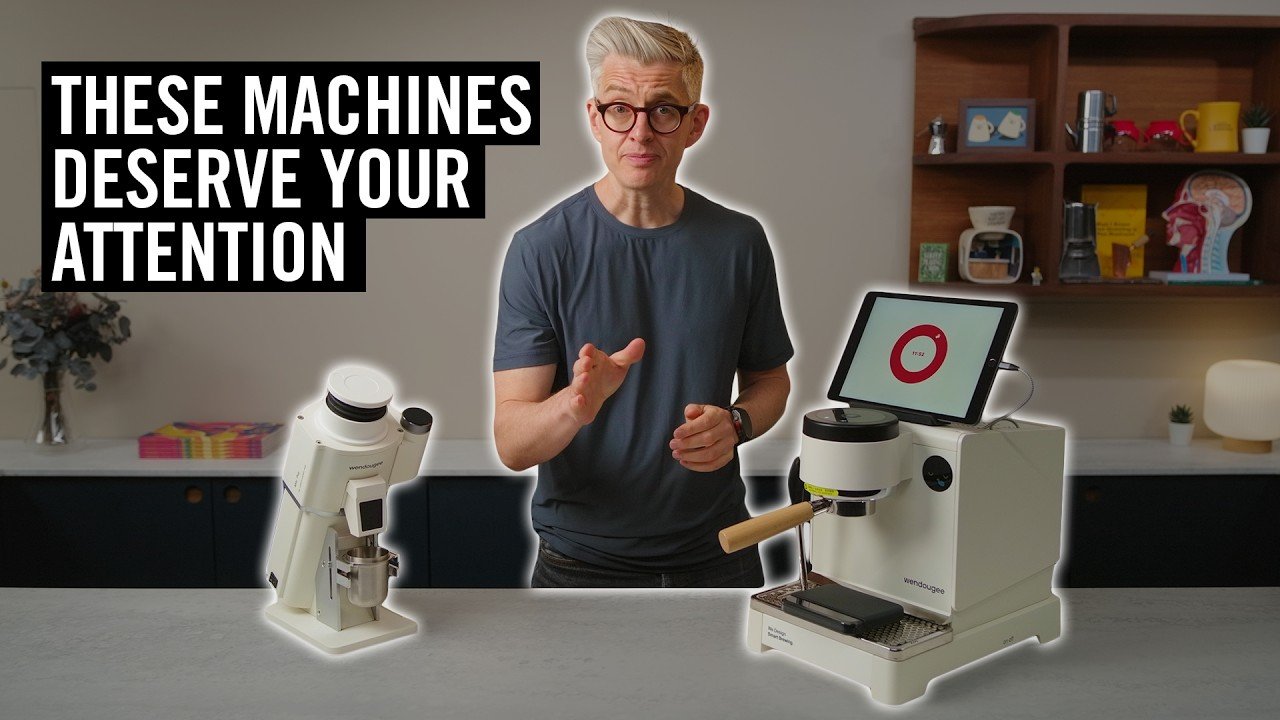
Wendougee, a relatively unknown name to many Western enthusiasts, is a commercial giant in China with the capacity to produce thousands of machines a month. They have recently pivoted toward the high-end domestic market, releasing products that are packed with technology and data-driven features. Today, explore two of their most intriguing offerings: the LITA espresso machine and the Milo Play grinder.
The Milo Play Grinder: Innovation Meets Practical Hurdles
The Milo Play is a 64mm flat burr grinder that retails for approximately $1,000. On the surface, it shares many characteristics with the modern crop of premium grinders: it’s a single-dose machine, features variable RPM, and has a sleek, minimalist aesthetic. However, once you dig into the mechanics, it becomes clear that this is both one of the most innovative and most frustrating grinders on the market.
Digital Precision and Repeatability
The standout feature of the Milo Play is its digital burr gap adjustment. Unlike traditional grinders where you turn a physical collar or dial, the Milo Play uses a digital display and a motor to adjust the distance between the burrs micron by micron.
In testing, this system proved to be incredibly repeatable. If you set your espresso grind to 145 microns and then jump to 450 microns for filter coffee, the machine returns to the exact same setting with startling accuracy. This level of precision is typically reserved for high-end commercial units like the Mahlkoenig EK Omnia. For a home user, the ability to save presets for different beans or brew methods and have the grinder mechanically adjust itself is a genuine game-changer.
Design and Material Choices
While the technology inside is forward-thinking, the physical build of the Milo Play raises some eyebrows. The main body is sturdy metal, but several components—including the top and certain trim pieces—are made of plastic. Curiously, the plastic parts come in slightly different shades of white, leading to a mismatched, “creamy” versus “stark white” appearance.
Furthermore, the grinder pulls about seven watts of power even when idle, which manifests as a constant, mild warmth in the motor. While not a safety hazard, it’s an odd quirk that suggests the internal electronics could benefit from further refinement.
The Retention and Regrinding Issue
The biggest drawback of the Milo Play is its retention. In an era where “zero retention” is the industry benchmark, finding variances of up to 0.5 grams is disappointing. The grinder seems to “hide” coffee in strange internal pockets. Even the mechanical “knocker” designed to clear the chute feels ineffective and tends to collect grime quickly.
Perhaps more concerning is the potential for “regrinding.” If the exit path for the coffee is slightly obstructed—likely by a stiff or poorly angled clump crusher—the grounds spend too much time in the burr chamber. This leads to heat buildup and an excess of “fines” (micro-particles), which can result in a muddy flavor profile that lacks the clarity sought by modern espresso enthusiasts.
The Wendougee LITA: A Compact Powerhouse
The LITA is a compact, dual-boiler espresso machine priced around $2,000. It enters a “data-driven” niche currently dominated by the Decent espresso machine. With pressure profiling, flow profiling, and weighing-scale integration, it offers a suite of features that would typically cost twice as much.
The Tablet-First Philosophy
One of the most striking things about the LITA is that it doesn’t actually come with a tablet. Wendougee assumes that many modern households have a spare iPad or Android tablet lying around. While the machine has a small circular display and basic physical buttons for standalone operation, its true power is unlocked via a Bluetooth-connected device.
The app allows for “Professional Mode,” where users can build complex pressure and flow curves. You can program a five-second pre-infusion at two bars, a ramp-up to nine bars, and a gradual decline to six bars. It’s a playground for the “coffee nerd” who wants total control over every variable.
Smart Integration with BooKoo Scales
The LITA can pair directly with modern smart scales (specifically those from BooKoo). This allows for “brewing by weight,” where the machine automatically stops the shot once it detects a specific mass in the cup. This is significantly more accurate than volumetric dosing, which only measures the water leaving the boiler, not the liquid actually ending up in your espresso.
Thermal Stability and Performance
As a dual-boiler machine with a saturated group head, the LITA is built for stability. In testing, the machine required a bit of a “warm-up” period; the first one or two shots tended to run slightly cooler than the target temperature. However, once the metal in the group head reached equilibrium, the thermal stability was impressive.
The pressure delivery is consistent, and the steam wand—operated by a single physical button—performs admirably, producing high-quality microfoam for lattes and flat whites.
Comparing the LITA to the Decent DE1
Because of its form factor and tablet-driven interface, the LITA is inevitably compared to the Decent DE1. While the LITA is a capable machine, it currently lacks the two things that make the Decent a legend: software maturity and community.
- Software: The Wendougee app, while functional, still suffers from “beta” bugs and clunky UI/UX. Navigating menus with the machine’s click-wheel or the tablet app can sometimes be unintuitive.
- Community: The Decent has a “rabid” following of users who share profiles, create custom software “skins,” and provide peer-to-peer tech support. Wendougee has a “Community” tab in their app, but it feels like a ghost town compared to the thriving ecosystem surrounding its competitor.
The Future of Chinese Coffee Brands
The Wendougee LITA and Milo Play represent a fascinating tipping point. They prove that Chinese manufacturers are no longer just followers—they are innovating in ways that Western brands have yet to match, particularly regarding digital integration and price-to-performance ratios.
While there are “version one” issues—such as material choices on the grinder and software bugs in the espresso machine—these are not insurmountable hurdles. Given the massive scale of the Chinese domestic coffee market, Wendougee has the resources to iterate rapidly.
If you are a tinkerer who loves data and wants to experiment with the cutting edge of espresso technology without spending $5,000, these machines are worth your attention. However, potential buyers should consider the level of local support available in their region, as buying directly from overseas can make after-sales service a challenge.
The “Italian Era” of espresso isn’t over, but the “Chinese Era” is undeniably here, bringing with it a level of digitization and precision that is set to redefine the home barista experience.
Source: Coffee Talk