

What's next in sustainable foodservice packaging – BeanScene

As sustainable food service packaging grows in sophistication and Australian legislation continues to change, what trends does BioPak’s Richard Fine foresee in this space?
When Richard Fine founded BioPak in 2006, the word “sustainability” was often dismissed as a corporate buzzword rather than a business mandate.
Nearly two decades on and the packaging industry is undergoing a serious overhaul – and the future he expects will be defined by circularity, simplicity, and transparency. However, a focus only on the packaging, without considering the whole picture, Richard says, means our ability to meaningfully protect the planet and better manage resources is limited.
In the rapidly changing world of food service packaging, nothing is guaranteed, but Richard has some well-informed predictions – both long- and short-term – along with a roadmap for BioPak to actively engage with policymakers, ensuring businesses thrive and evolving legislation serves true environmental progress.
Among those key trends, he identifies stronger government regulation as a top contender, with an increasing duty on companies to ensure they’re accountable for all touchpoints of the supply chain.
“Governments are cracking down on single-use plastics and moving towards extended producer responsibility programs, meaning companies like ours, that supply the packaging, also take responsibility for what happens to it after it has been used,” says Richard.
“We’re working closely with food service, waste management companies, composters and relevant industry associations as well as policymakers to make sure these changes lead to outcomes that result in truly circular solutions, not just nice words in a policy document.”
Richard also points to a shift towards simpler materials and systems that reflect how food service waste actually behaves. In cafés, packaging is almost always contaminated with food, which undermines paper recycling outcomes. Composting works because it accepts this reality, allowing food and packaging to be recovered together and keeping organics out of landfill.
“The packaging fits the waste system, rather than fighting against it.”
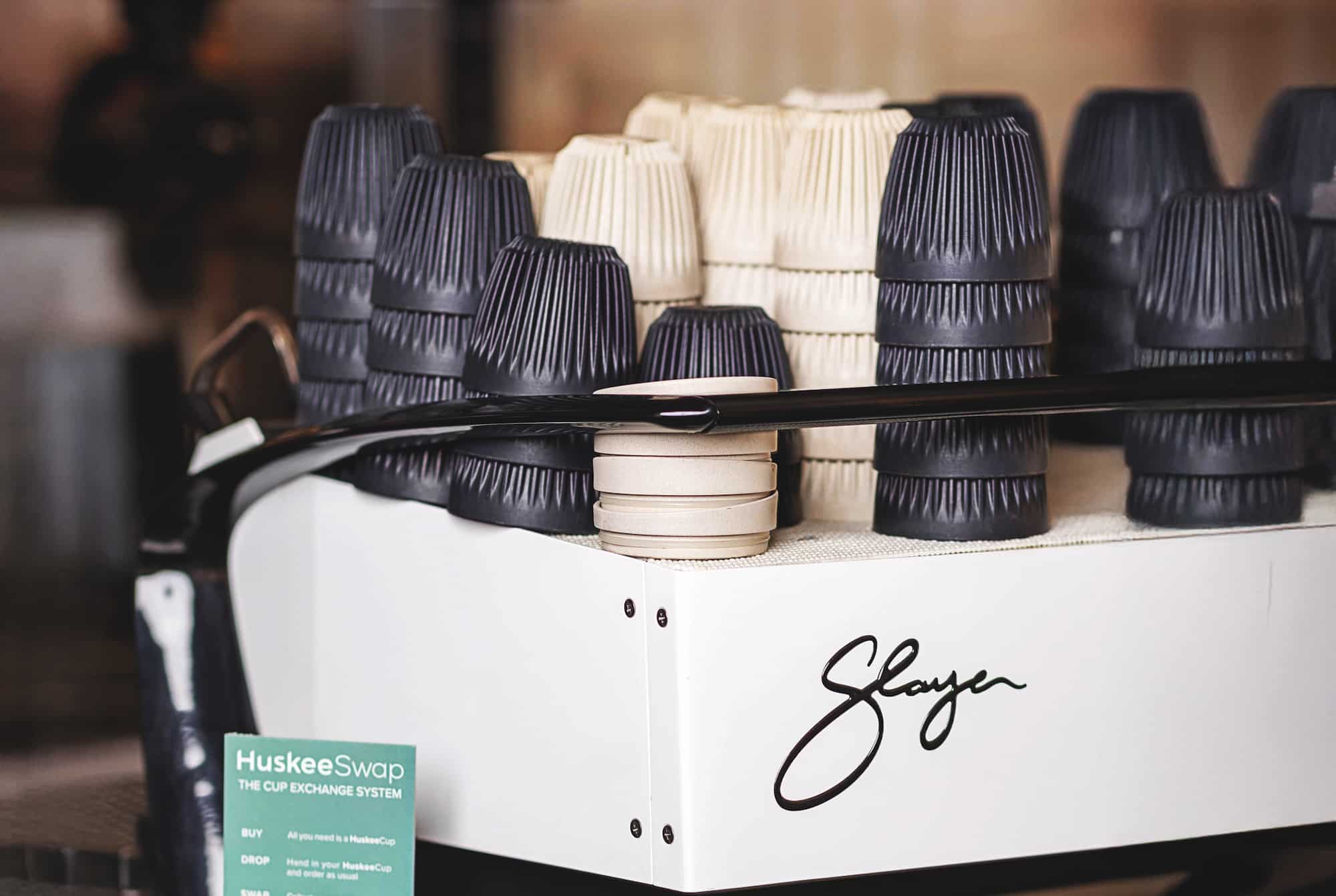
There’s also an exciting shift towards reusables, or packaging as a service, allowing packaging to exist in a circular system – such as Huskee’s two reusable systems: Borrow by Huskee and HuskeeSwap. (The company was acquired by BioPak in April 2024.)
This shift is being driven by rapid advances in technology, with library-style systems of smart packaging, tracking, and return schemes already disrupting the market.
“The takeaway cups of 2026 might come with a data trail, and not just a drink. That’s an exciting thing to think about,” says Richard.
While BioPak stays ahead of industry trends and innovations, one recent development still caught Richard by surprise.
“I’ve noticed just how quickly the market has embraced sustainable alternatives. Before the regulations were implemented, sustainability used to be a compromise; now it’s a brand advantage,” he says.
“Cafés proudly tell customers about their compostable cups, and consumers are asking for lower impact options.”
It’s with these developments in mind that BioPak balances business prospects with its own sustainability objectives.
“We acquire and partner with companies where we see an opportunity to drive the industry forward. Every strategic move is measured against our purpose,” says Richard.
“We ask if the decision advances the transition away from the linear fossil fuel made, single-use packaging, and towards circular outcomes. If it’s yes, we invest; if it’s not, we rethink and recalibrate.”
Australia is quickly evolving its legislation around single-use plastic packaging, particularly at state and local levels. This is something that “keeps [BioPak] on our toes”, but Richard sees it as a chance to work with government, rather than against it.
The company is regularly involved in policy discussions, sharing its expertise with policymakers. It’s closely tied to the Australian Packaging Covenant Organisation (APCO), with Richard participating in various working groups, and engaging directly with the organisation to identify and define sustainable packaging pathways for Australian businesses.
The company also engages with the Department of Climate Change, Energy, the Environment and Water (DCCEEW), the Environment Protection Authority (EPA), the Australasian Bioplastics Association (ABA), and the Australian Organics Recycling Association (AORA), to offer deep experience and insight from the food service industry, with a genuine dedication to environmental progress.
“We feel a responsibility to share our industry understanding and knowledge to ensure that any policies adopted by the Australian Government are based on actual data and facts, not assumptions,” he says.
“We push for decisions based on evidence. What’s missing today is consistency across the food service sector, particularly around single-use plastic bans and end-of-life pathways, so cafés and consumers aren’t forced to navigate multiple, conflicting rules.”
Even with its many moving parts, Richard emphasises that lasting change in the packaging industry is ultimately achieved through one thing: collaboration.
“If the food service industry, suppliers, governments, waste management companies and recyclers all work together, Australia can lead the world in circular food service packaging,” he says.
“Coffee culture is built on community in this country – now we have an opportunity to build circularity, too.”
For more information, visit biopak.com
This article appears in the February 2025 edition of BeanScene. Subscribe HERE.
Source: Bean Scene Mag