


Deforestation in Brazil is Threatening the Future of Coffee—Here's What to Know


Etelle Higonnet of Coffee Watch explains what’s at risk, and how the industry can pave a better path forward.
BY BHAVI PATEL
BARISTA MAGAZINE ONLINE
Photos courtesy of Coffee Watch
The aroma of your morning coffee carries an unsettling truth: The very forests that once sustained Brazil‘s coffee industry are vanishing, threatening the future of the crop itself. A groundbreaking report by Coffee Watch reveals that Brazil’s coffee heartland lost more than 11 million hectares of forest between 2001 and 2023, with at least 312,803 hectares directly cleared for coffee cultivation.
This isn’t just an environmental catastrophe—it’s an economic time bomb ticking beneath the industry’s feet. Today, we delve deeper into the report, what it means for coffee professionals, and how to move forward.
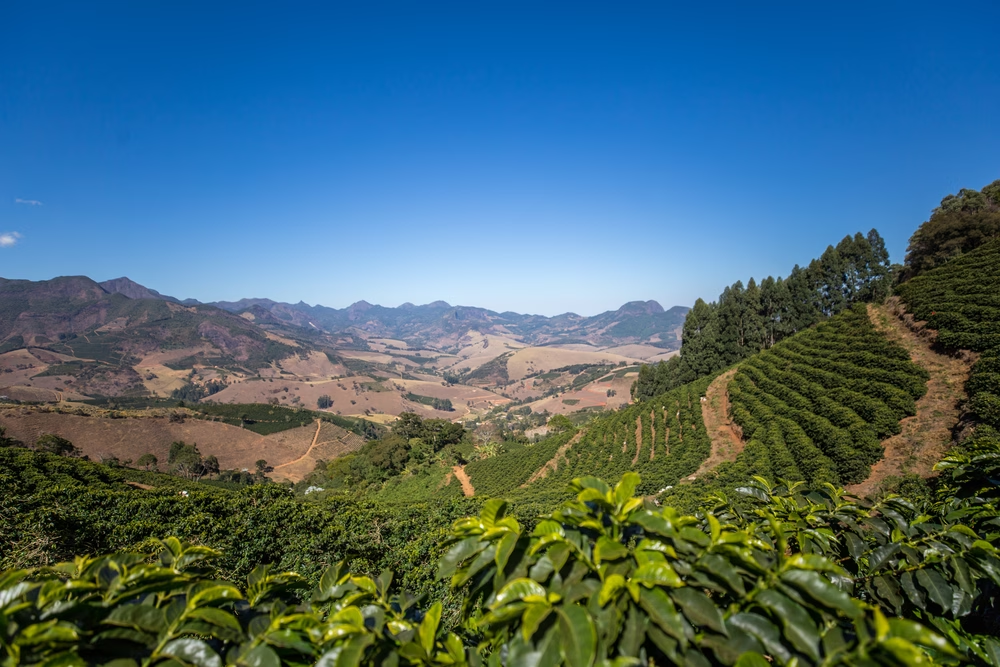
The Deforestation-Drought Connection Reshaping Coffee Country
Satellite data reveals 737,000 hectares of forest loss inside coffee farms, with 77% occurring in the Cerrado biome and 20% in the Atlantic Forest. But the devastation extends far beyond the trees themselves.
“Coffee has driven massive deforestation in Brazil, especially in the last few decades, and it is still destroying forests to this day,” says Etelle Higonnet, Director of Coffee Watch. “Brazil needs to reverse course urgently because this deforestation is not just a carbon and biodiversity disaster—it is also killing rains and leading to crop failures.”
The connection is stark: Forests regulate rainfall patterns, and their destruction disrupts the water cycles coffee depends on. In 2014, rainfall fell up to 50% below normal in parts of Minas Gerais, Brazil’s leading coffee-producing region, and 8 of the last 10 years registered deficits. Etelle explains the mechanism succinctly: “Destroying the forests is killing the rains, which hurts soil moisture. The droughts, in turn, cause crop failures, including in coffee.”
When Soil Loses Its Memory
NASA SMAP data reveals soil moisture declines up to 25% over six years in top coffee-producing zones. These are not just temporary setbacks—they represent fundamental shifts in the landscape’s capacity to sustain agriculture.
The economic consequences are mounting. Landmark droughts in 2016–17, 2019–20, and 2023 slashed yields and contributed to over 40% price rises in 2023–24. Climate modeling paints an even grimmer picture: Up to two-thirds of Brazil’s suitable Arabica area could be lost by 2050.
The European Union’s Deforestation Regulation (EUDR) adds urgency to the crisis. “Some deforestation we found is after the EUDR cutoff date. That points to potential noncompliance,” Etelle says, highlighting risks for exporters who haven’t ensured traceability in their supply chains.

A Solution Hiding in Plain Sight
Perhaps the most frustrating revelation: We already know how to fix this. Agroforestry zones showed greater moisture stability even during droughts—yet less than 1% of Brazil’s key coffee zones use agroforestry today.
“Half of global coffee will vanish by 2050 unless we course correct, transition to agroforestry at scale, and reforest wherever possible,” Etelle told Barista Magazine.
Charting a Better Path Forward
The report’s methodology—combining satellite imagery from CHIRPS, NASA SMAP soil moisture readings, and land use data from MapBiomas, Hansen, and SPAM—provides unprecedented clarity on coffee’s environmental footprint.
For Brazil specifically, Etelle outlined immediate action steps: “Brazil can immediately study deforestation for coffee closely, crack down on it wherever possible, help all its coffee farmers to transition to agroforestry, and regreen and reforest all around coffee wherever possible to try to stabilize the rains and soil moisture.”
A Global Wake-Up Call
While this report focuses on Brazil, the implications extend worldwide. “What we found in Brazil is true for most other coffee-producing countries,” Etelle says. “They have serious historical and current deforestation problems. And the deforestation for coffee was so widespread that it has affected rainfall and soil moisture, which is jeopardizing coffee’s future.”
The path forward requires collective action: transparent monitoring, zero-deforestation commitments, investment in agroforestry, and support for restoration projects. The coffee industry stands at a crossroads: Embrace regenerative practices, or watch the industry’s foundation crumble beneath changing climate realities.
The choice isn’t between forests and coffee anymore. It is about recognizing that, without forests, there will be no coffee to save.
ABOUT THE AUTHOR
Bhavi Patel is a food writer focusing on coffee and tea, and a brand-building specialist with a background in dairy technology and an interest in culinary history and sensory perception of food.

Subscribe and More!
As always, you can read Barista Magazine in paper by subscribing or ordering an issue.
Read the October + November 2025 Issue for free with our digital edition.
For free access to more than five years’ worth of issues, visit our digital edition archives here.
Source: Barista Magazine