


Australia's barista workforce exceeds 44,000, ATO data reveals – BeanScene

Australia’s barista workforce has continued to expand, with more than 44,000 people now identifying with the profession as average taxable income increased to $33,265, new Australian Taxation Office (ATO) data shows.
The figures for the 2023–24 financial year provide the latest snapshot of taxable incomes across Australia, including baristas, café workers, and café or restaurant managers.
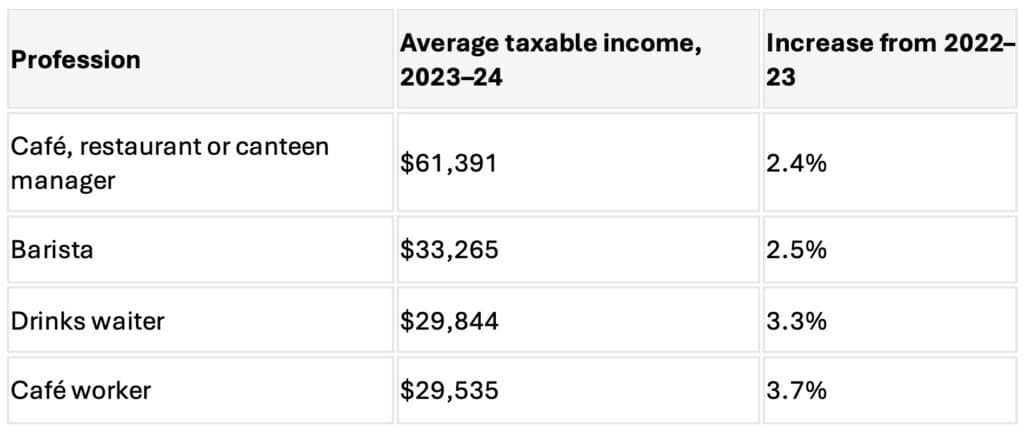
According to the data, the average taxable income of Australian baristas increased 2.5 per cent year-on-year, from $32,447 in 2022–23 to $33,265 in 2023–24.
At the same time, the number of people identifying their occupation as barista increased by 2,301, or 5.5 per cent, from 41,921 to 44,222.
This continues the growth recorded in the previous ATO data, when BeanScene reported the number of baristas had already increased by around 3,100 in a single year.
Women continue to make up around three-quarters of Australia’s barista workforce. The number of female baristas rose from 31,226 to 33,182 and their average taxable income increased 3.2 per cent, from $31,383 to $32,398.
Male barista numbers increased from 10,695 to 11,040, while average taxable income rose 0.9 per cent, from $35,554 to $35,869.
Café workers recorded slightly stronger income growth.
Average taxable income across the profession increased 3.7 per cent, from $28,474 to $29,535. Meanwhile, the number of café workers grew by 1,670, or 2.8 per cent, from 59,540 to 61,210.
Among the 47,885 female café workers captured in the latest data, average taxable income increased 4.4 per cent, from $28,366 to $29,621. The 13,325 male café workers recorded average taxable income of $29,226, up 1.2 per cent from $28,868.
The latest figures therefore show female café workers reporting a slightly higher average taxable income than their male counterparts, reversing the position recorded in 2022–23.
At management level, average taxable income for café, restaurant or canteen managers increased 2.4 per cent, from $59,938 to $61,391.
The number of managers also increased slightly, from 51,851 to 52,407.
Female managers reported average taxable income of $56,276, a 3.7 per cent increase from $54,267 in 2022–23. For male managers, average taxable income increased 1.2 per cent, from $67,512 to $68,290.
The figures continue to show a substantial difference in reported taxable incomes between frontline café roles and management positions. On average, managers recorded $28,126 more taxable income than baristas and $31,856 more than café workers in 2023–24.
Elsewhere in hospitality, the average taxable income of drinks waiters increased 3.3 per cent, from $28,885 to $29,844.
Unlike the café workforce, however, their numbers edged backwards. The number of people identifying as drinks waiters fell from 151,050 to 150,633.
Female drinks waiters averaged $29,389 in taxable income during 2023–24, up 3.3 per cent from $28,448, while male drinks waiters averaged $31,070, also around 3.3 per cent higher than the previous year’s $30,080.
Across the core café occupations, the latest figures point to a workforce that continues to expand.
The combined number of baristas, café workers and café, restaurant or canteen managers increased from 153,312 in 2022–23 to 157,839 in 2023–24, representing an additional 4,527 people.
Baristas recorded the fastest workforce growth of the three at 5.5 per cent, followed by café workers at 2.8 per cent and managers at 1.1 per cent.
However, growth in average taxable income was comparatively subdued. Café workers recorded the largest increase at 3.7 per cent, followed by baristas at 2.5 per cent and managers at 2.4 per cent.
It marks a slowdown from the increases highlighted in BeanScene’s 2025 analysis, when barista average taxable income had risen 6.5 per cent and café worker income had increased approximately 8.0 per cent between 2021–22 and 2022–23.
The data does not, however, represent a typical full-time salary or hourly wage.
As with previous ATO releases, it captures taxable income reported by individuals identifying with each occupation and does not establish whether they worked on a full-time, part-time, or casual basis.
This distinction is particularly relevant to hospitality, where working hours and employment arrangements can vary considerably.
Source: Bean Scene Mag