

Best Home Milk Frothers – CoffeeTalk

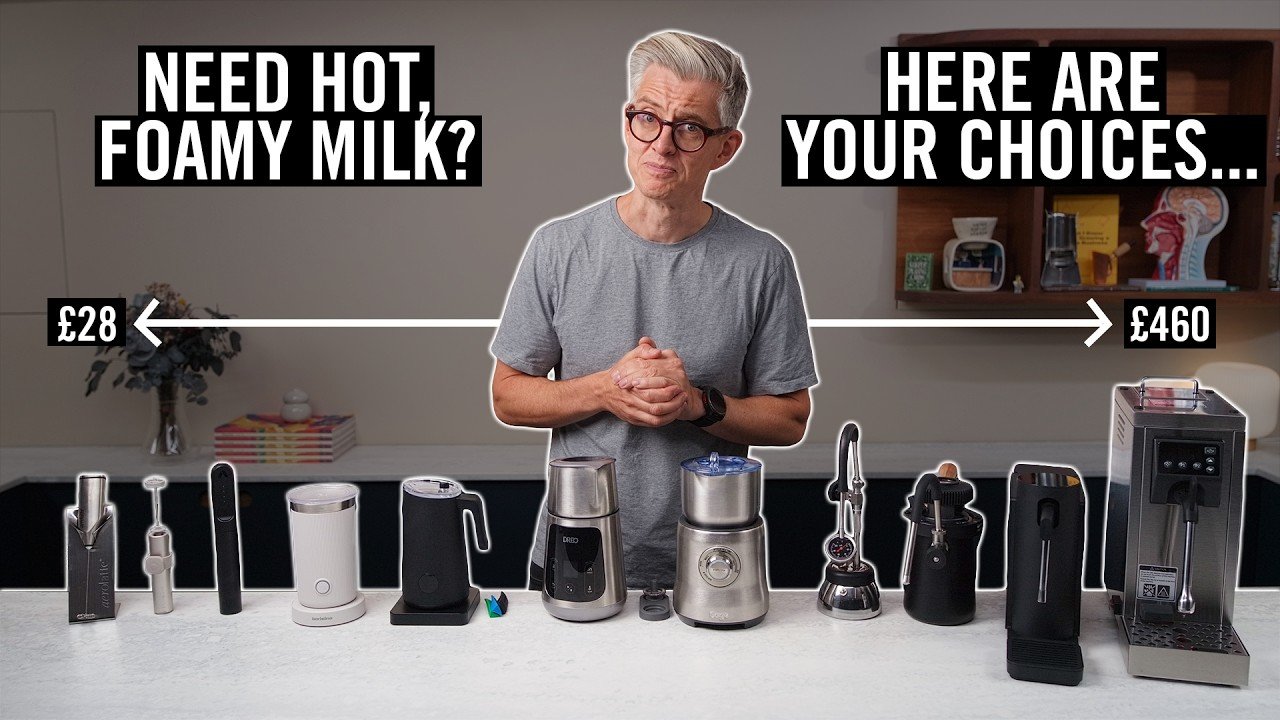
In the world of home coffee brewing, the market for milk frothing has exploded with innovation. Today, we can categorize the available solutions into three distinct groups: handheld electric whisks, all-in-one hands-free frothers, and dedicated steam-generating appliances. Each category offers a different balance of price, quality, and practicality.
Group 1: The Handheld Whisks (Manual Heating Required)
The most entry-level and affordable option involves using a handheld electric whisk. These tools are the “manual transmission” of the frothing world—they require the most skill and labor, but they offer high portability and a low barrier to entry.
The Original: Aerolatte
Coming in at approximately £28, the Aerolatte is the classic choice. It is a simple, battery-operated whisk that has remained largely unchanged for decades. While it is effective at creating foam, it requires you to heat your milk separately (usually in a microwave to about 55-60°C) and use a specific technique to incorporate air and then texture the milk. The results are decent, though it can be difficult to achieve the “wet” foam required for intricate latte art.
The Innovators: NanoFoamer and Outln
Moving up to the £50 range, we find a newer generation of whisks designed specifically for specialty coffee. The NanoFoamer and the Outln LattoGo replace the traditional spring coil with a fine mesh screen. This mesh “smashes” the bubbles into much smaller microbubbles, resulting in a texture that closely mimics a professional steam wand.
The Outln features a clever “belt” or stabilizer that helps guide the depth of the whisk, which is helpful for beginners. Both are rechargeable via USB-C, making them more practical than the battery-hungry Aerolatte. If you don’t mind the extra step of microwaving your milk, these handheld tools provide arguably the best value for money in terms of foam quality.
Group 2: All-in-One Hands-Free Frothers
For many, the appeal of a dedicated frother is the “set it and forget it” convenience. These machines heat and foam the milk simultaneously, allowing you to focus on pulling your espresso shot.
The Entry Level: Philips Baristina
At around £85, the Philips Baristina represents the standard magnetic whisk frother. While convenient, it suffers from a lack of control. You cannot adjust the temperature or the foam thickness, often resulting in a “dry” foam that sits on top of the coffee rather than integrating with it. Cleanup can also be a chore, as milk tends to bake onto the bottom heating element.
The Precision Choice: NanoFoamer PRO
The NanoFoamer PRO (£146) is a significant step up. Unlike cheaper models, it uses interchangeable flow controllers to manage how much air is injected. It is one of the few all-in-one carafes that allows you to pour genuine latte art directly from the vessel. The texture is nearly indistinguishable from a commercial machine, though the small silicone parts can be easy to lose and the price is steep.
The Balanced Contender: Dreo Milk Frother
At roughly £100, the Dreo offers a compelling middle ground. It features a sophisticated display with presets for different milk types (oat, almond, dairy) and specific drinks like flat whites. One of its best features is a detachable jug with no electronics in it, making it completely dishwasher safe—a massive win for daily practicality.
The Sage/Breville Milk Cafe
While Sage (Breville) is a giant in the coffee world, their standalone frother (£150+) feels somewhat dated in this lineup. It is bulky and tends to produce an excessive amount of foam, even on lower settings. Given the performance of the Dreo and NanoFoamer PRO, it is difficult to recommend the Sage unless you are specifically looking to match existing kitchen aesthetics.
Group 3: Standalone Steamers (The Professional Experience)
If you want the authentic experience of a barista, you need steam. Steam doesn’t just foam the milk; it adds moisture and creates a specific “vortex” that textures milk in a way whisks cannot.
Stovetop Options: Flair and Bellman
Stovetop steamers like the Flair Artiste (£172) are essentially pressure vessels you heat on a hob. Once the internal pressure reaches roughly 1.5 to 2 bars, you use a traditional steam wand to froth your milk.
- The Pro: It provides incredible steam power and is portable enough for camping.
- The Con: It takes a long time to heat up and requires careful monitoring of a pressure gauge. It is also not always compatible with induction hobs.
High-End Electric Steamers: Morning and WPM
At the top of the market are dedicated electric steam machines. These are for the enthusiast who wants a “dual boiler” experience without replacing their single-boiler espresso machine.
The Morning Dream is a piece of high-tech art. It features an induction-heated steam boiler, precise temperature sensors, and a digital interface that allows you to customize every aspect of the steam tip’s output. It is expensive and complex, but for those who want the absolute best-looking and best-performing standalone unit, this is it.
The WPM (Welhome Pro) is a more industrial alternative. It is essentially a steam boiler in a box. It’s loud and bulky, but it delivers consistent, commercial-grade steam. However, at a price point often exceeding £400, it enters the territory where one might consider simply buying a new espresso machine with a built-in boiler.
Choosing the right milk frother depends entirely on your workflow and budget.
- On a Budget: Grab an Aerolatte or a NanoFoamer Lithium. The extra step of heating the milk in the microwave is a small price to pay for the quality you can achieve with a bit of practice.
- For Convenience: The Dreo is the winner here. It offers the best balance of price, ease of cleaning, and “good enough” microfoam for most home drinkers.
- For the Perfectionist: The NanoFoamer PRO or the Morning Dream are the gold standards. These machines bridge the gap between home convenience and cafe quality, allowing for professional-level latte art.
Source: Coffee Talk